

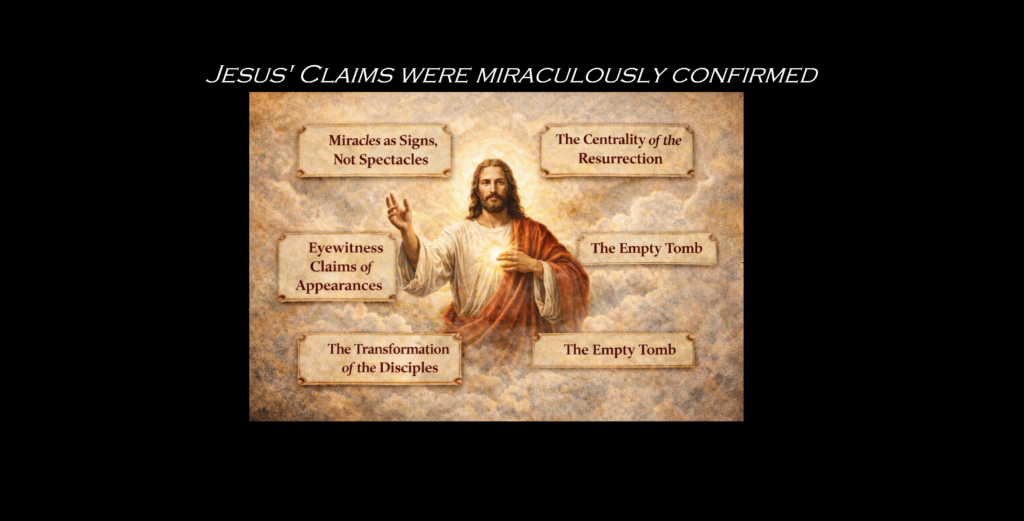
If Jesus made extraordinary claims about Himself, the natural question follows: Was there any evidence to support them?
According to the New Testament documents, Jesus did not ask people to believe His identity without demonstration.
His teachings were accompanied by acts described as miracles – public events meant to confirm that His authority was not merely rhetorical, but divine. Central among these was the claim that He rose from the dead.
The argument is straightforward: if the miracles occurred, especially the Resurrection, then they validate who Jesus said He was.
Miracles as Signs, Not Spectacles
In the Gospel accounts, miracles are not random displays of power. They are presented as “signs” – acts pointing beyond themselves. Jesus heals the sick, restores sight to the blind, calms storms, and raises the dead. These actions are framed not merely as compassionate deeds, but as indicators of authority over nature, disease, and even death itself.
Importantly, these events are described as public. They occur in towns, before crowds, and in the presence of both followers and critics. The narratives do not portray hidden mystical experiences, but observable acts that provoke widespread reaction.
Even His opponents, in several accounts, do not deny that unusual works occurred. Instead, they debate the source of His power.
The Centrality of the Resurrection
While many miracles are recorded, the Resurrection stands at the center of Christian belief.
Jesus predicted His death and resurrection multiple times, according to the Gospels. If He remained in the grave, His claims would have collapsed. A failed prediction would have exposed Him as mistaken.
Instead, the earliest Christian proclamation was this: He rose.
This was not presented as symbolic language about hope or renewal. It was announced as a historical event – an empty tomb and appearances to numerous witnesses.
The Empty Tomb
All four Gospels report that Jesus’ tomb was found empty shortly after His burial. This detail is significant for several reasons:
- The burial location was known.
- The proclamation of the Resurrection began in the same city where He had been executed.
- If the body had remained in the tomb, producing it would have quickly silenced the movement.
Additionally, the accounts consistently report that women were the first witnesses to the empty tomb.
In that cultural context, women’s testimony carried less legal weight. If the story were invented, it is unlikely that this detail would have been included.
Eyewitness Claims of Appearances
Beyond the empty tomb, early Christian writings claim that Jesus appeared alive to individuals and groups. These appearances were described as physical encounters – conversations, shared meals, and extended interactions.
One early creed, preserved in a letter written within decades of the crucifixion, lists multiple named witnesses, including a group of more than five hundred people at once. The inclusion of named individuals suggests an invitation to verification at the time.
The message was not “we feel He lives on spiritually.” It was “we saw Him alive.”
The Transformation of the Disciples
Before the crucifixion, the disciples are portrayed as fearful and scattered. Afterward, they publicly proclaim the Resurrection despite threats, imprisonment, and persecution.
While courage alone does not prove truth, it raises an important question: what explains the dramatic shift?
People may suffer for beliefs they think are true. But it is far less plausible that multiple individuals would endure hardship and death for something they knew to be fabricated.
The simplest explanation offered by the text is that they genuinely believed they had encountered the risen Jesus.
Alternative Explanations
Over time, alternative theories have been proposed: hallucinations, stolen bodies, mistaken identity. Each attempts to account for parts of the data.
However, these explanations often struggle to explain the combination of:
- The empty tomb
- Multiple reported appearances
- The early and public proclamation
- The rapid growth of the movement in hostile territory
The Resurrection hypothesis uniquely addresses all of these elements together.
Why It Matters
If Jesus performed miracles, they demand explanation. If He rose from the dead, His claims about Himself cannot be dismissed as exaggeration or legend.
The Resurrection would not merely be a remarkable event – it would be divine confirmation.
It would mean that death is not ultimate. That Jesus’ authority extends beyond the grave. That His words carry eternal weight.
The Christian claim is bold: God validated Jesus not only through teaching or moral example, but through power over life and death itself.
If that claim is true, then the question is no longer whether Jesus was a good teacher.
The question becomes whether He is Lord.