

When discussing Christianity, everything ultimately rises or falls on a simple question:
Can the documents that tell the story be trusted?
The credibility of the New Testament is not merely a matter of faith. It is a historical question.
Like any set of ancient documents, it can be examined through manuscript evidence, authorship, dating, and transmission.
When evaluated by the same standards used for other ancient works, the New Testament stands on remarkably solid ground.
Manuscript Evidence: An Unmatched Foundation
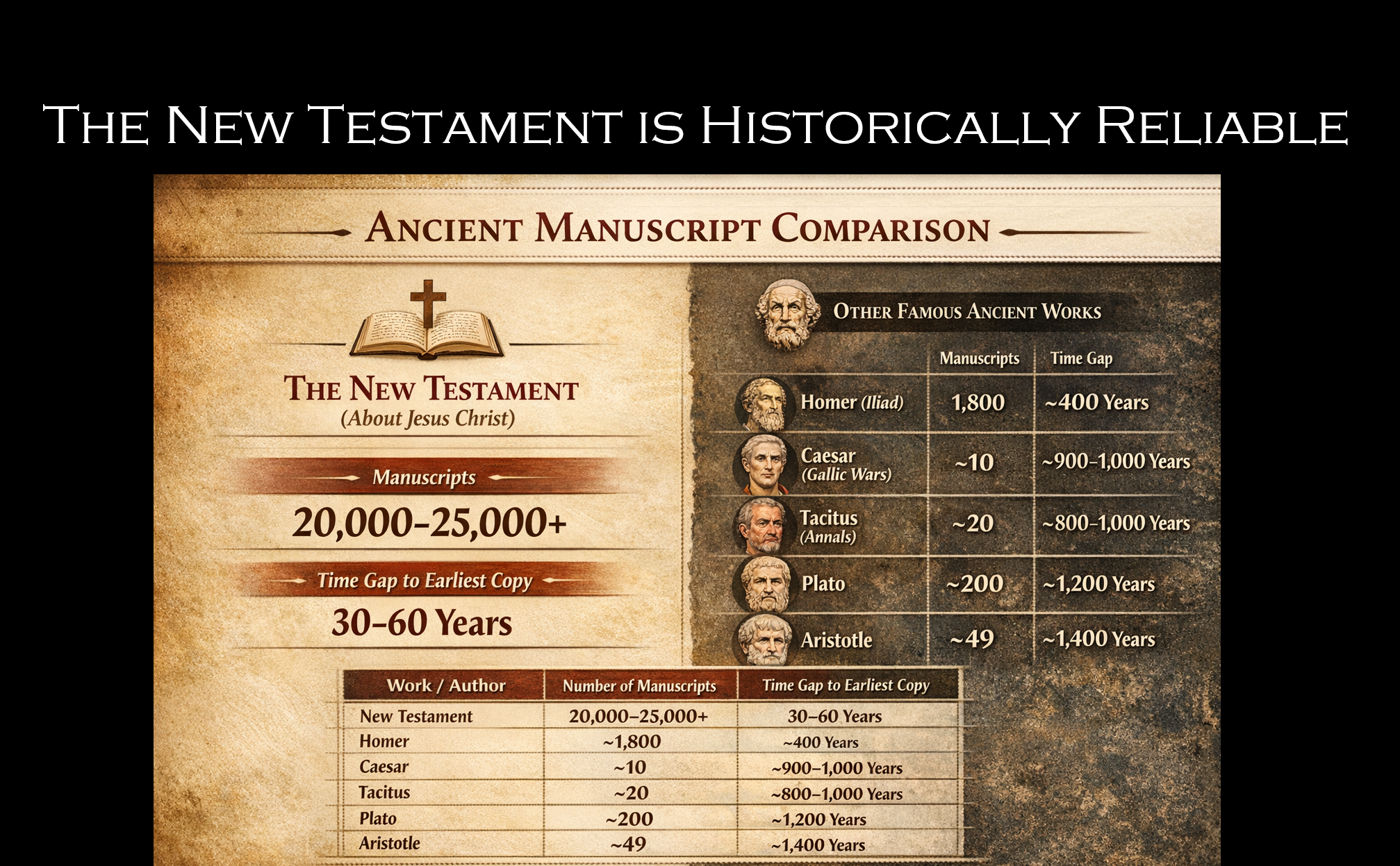
The New Testament is supported by an extraordinary number of surviving manuscripts.
Thousands of Greek manuscripts exist, along with early translations into Latin, Syriac, and Coptic. Portions of the text appear in manuscripts dating very close to the time of the originals. Some fragments are dated within a century of composition, which is exceptionally early in the world of ancient literature.
By comparison, many respected classical works – such as those by ancient historians or philosophers – survive in far fewer copies and often with much greater gaps between the original writing and the earliest surviving manuscript.
The sheer volume of New Testament manuscripts allows scholars to cross-check copies against one another. This process makes it possible to identify and correct scribal variations with a high degree of confidence.
The result is not blind faith in a single fragile copy, but a robust textual tradition that can be examined, compared, and tested.
Authorship and Early Attribution
The books of the New Testament are not anonymous myths that emerged centuries later. They are connected to identifiable individuals within the first-century Christian movement.
The Gospels are traditionally attributed to Matthew, Mark, Luke, and John. Early Christian writers – living within generations of the apostles – consistently affirmed these authorships. There is no competing early tradition assigning these books to other figures.
Additionally, several New Testament letters explicitly identify their authors, including those attributed to Paul. These letters often contain personal details, historical references, and relational language consistent with authentic correspondence.
Scholars may debate certain details, but the overwhelming consensus is that the New Testament documents were written within the first century – while eyewitnesses were still alive and capable of challenging false claims.
That timing matters. Legends typically require generations to develop. The New Testament writings appear too early for myth to have replaced memory.
Transmission: Preserved Through Careful Copying
Before the printing press, all documents were copied by hand. Variations in wording naturally occurred in the copying process. However, textual criticism – the discipline of comparing manuscripts – demonstrates that the vast majority of differences are minor: spelling changes, word order shifts, or stylistic variations that do not alter core meaning.
No essential Christian doctrine depends on a disputed text.
Moreover, the geographic spread of early manuscripts strengthens the case for reliable transmission. Copies circulated widely across the Mediterranean world. This wide distribution makes the idea of a coordinated, large-scale corruption of the text historically implausible.
The New Testament was not controlled by a single centralized authority in its earliest centuries. Instead, it was copied and shared across diverse communities, making wholesale alteration extremely unlikely.
Historical Markers Within the Text
The New Testament documents reflect detailed knowledge of first-century geography, political leaders, cultural practices, and religious debates. Archaeology and non-Christian sources frequently confirm these contextual details.
Writers refer to real cities, real rulers, and real controversies. They include embarrassing moments about their own leaders. They portray events in ways that invite verification rather than avoiding scrutiny.
These characteristics align more closely with historical reporting than with legendary fiction.
Evaluating the Evidence Fairly
No ancient document can be proven with absolute mathematical certainty. Historical reasoning works differently. It asks which explanation best fits the available evidence.
When considering:
- The early dating of the documents
- The large and diverse manuscript base
- The consistency of authorship traditions
- The historical details embedded in the text
The New Testament emerges as one of the most well-supported collections of writings from the ancient world.
This does not automatically prove every theological claim within it. But it does establish that the documents themselves are historically credible and worthy of serious consideration.
Why It Matters
If the New Testament is historically reliable, then the events it records – especially concerning the life, death, and reported resurrection of Jesus – cannot be dismissed as late legend or careless mythmaking.
The discussion then shifts from “Can we trust the documents?” to “What do we do with what they say?”
History invites investigation. And the New Testament, examined honestly and carefully, stands up far better than many assume.
The question is no longer whether it deserves attention.
The question is whether we are willing to follow the evidence wherever it leads.