

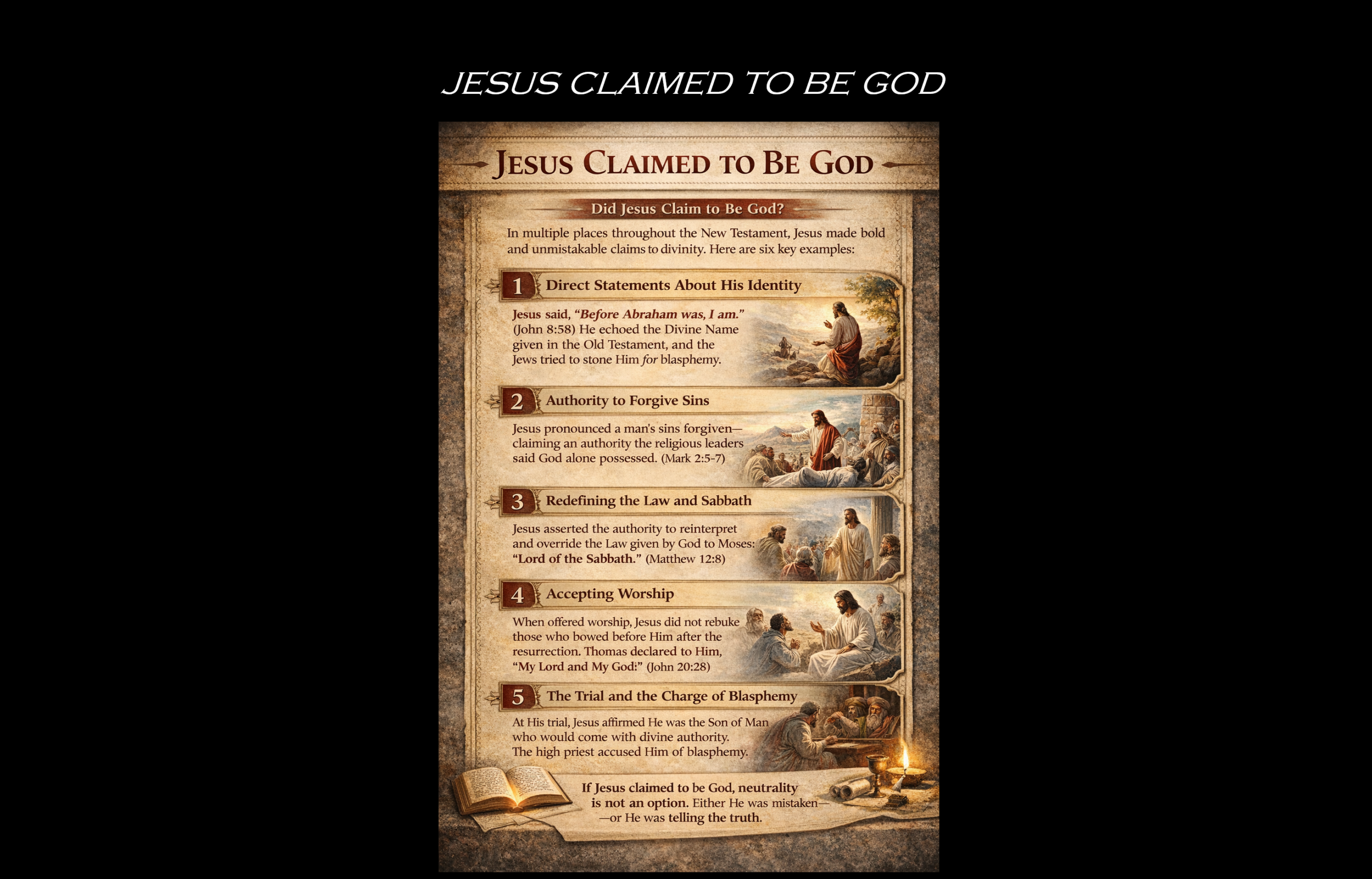
Few questions are more significant than this one: Did Jesus actually claim to be God?
Some suggest that Jesus was merely a moral teacher whose followers later exaggerated His identity. Others argue that the earliest Christian writings present Him as making bold and unmistakable claims about Himself – claims that go far beyond the role of prophet or rabbi.
When the New Testament documents are examined carefully, they reveal that Jesus spoke and acted in ways that implied divine authority and identity.
Direct Statements About His Identity
In several passages, Jesus makes statements that His audience understood as divine claims.
For example, in the Gospel of John, Jesus declares, “Before Abraham was, I am.” This phrase echoes the divine name revealed in the Old Testament. His listeners respond by attempting to stone Him – an action consistent with a charge of blasphemy. They clearly interpreted His words as a claim to equality with God.
On other occasions, Jesus refers to Himself as one with the Father. Again, His opponents accuse Him of making Himself equal with God.
These reactions are significant. First-century Jewish listeners were fiercely monotheistic. They did not casually interpret statements as divine claims. The hostility Jesus faced suggests that His words crossed a line in their understanding.
Authority to Forgive Sins
Jesus did not merely teach about God – He exercised authority that belonged to God.
In one well-known account, Jesus forgives a man’s sins before healing him physically. The religious leaders present immediately object. Their reasoning was straightforward: only God can forgive sins committed against Him. Instead of correcting their assumption, Jesus reinforces His authority by performing a visible miracle to validate His invisible claim.
The narrative presents forgiveness not as a prayer request to God, but as something Jesus Himself grants.
That is not the behavior of someone claiming only to be a messenger.
Redefining the Law and Sabbath
In Jewish thought, the Law was given by God through Moses. Yet Jesus repeatedly speaks with personal authority over it.
He says, “You have heard it said… but I say to you,” positioning His teaching alongside – and above – traditional interpretations. He also claims to be “Lord of the Sabbath,” asserting authority over an institution established by God at creation.
Such claims go beyond prophetic correction. They reflect a self-understanding that places Him at the center of divine authority.
Accepting Worship
Throughout the Gospels, individuals respond to Jesus with acts of worship. In Jewish tradition, worship belongs to God alone. When others in Scripture are mistakenly worshiped, they immediately refuse it.
Jesus, however, does not rebuke those who bow before Him. Instead, the narratives portray these moments as appropriate responses to His identity.
After the resurrection, the disciples worship Him. The text offers no correction – only affirmation.
The Trial and the Charge of Blasphemy
At His trial before the Jewish authorities, Jesus is asked directly whether He is the Messiah, the Son of the Blessed One.
He responds by referencing imagery from Daniel’s vision of the “Son of Man” coming with divine authority and seated at the right hand of power.
The high priest tears his garments and accuses Him of blasphemy.
This reaction reveals how Jesus’ words were understood in that context. The charge was not that He was a good teacher or misguided reformer. It was that He claimed a status belonging uniquely to God.
The Earliest Christian Belief
The earliest Christian writings, including letters written within decades of Jesus’ death, present Him as divine. They describe Him as preexistent, involved in creation, and worthy of worship.
These beliefs did not slowly evolve over centuries. They appear immediately in the first generation of the Christian movement.
If Jesus never made divine claims, it is difficult to explain why His earliest followers – many of whom were strict monotheistic Jews – so quickly reoriented their understanding of God around Him.
The Logical Tension
If the Gospel accounts are historically reliable, then Jesus did not leave open the option of being merely a moral teacher.
His claims force a decision.
If false, they would make Him either deceptive or deluded.
If true, they redefine everything.
The idea that He never claimed divinity does not fit the textual evidence or the reaction of His contemporaries.
Why It Matters
If Jesus claimed to be God, then neutrality is not an option.
His life and words demand a response. Either He was mistaken – or He was who He said He was.
The question is not simply what we think about His teachings. It is what we think about His identity.
And that question reaches into every other question about meaning, truth, and eternity.