

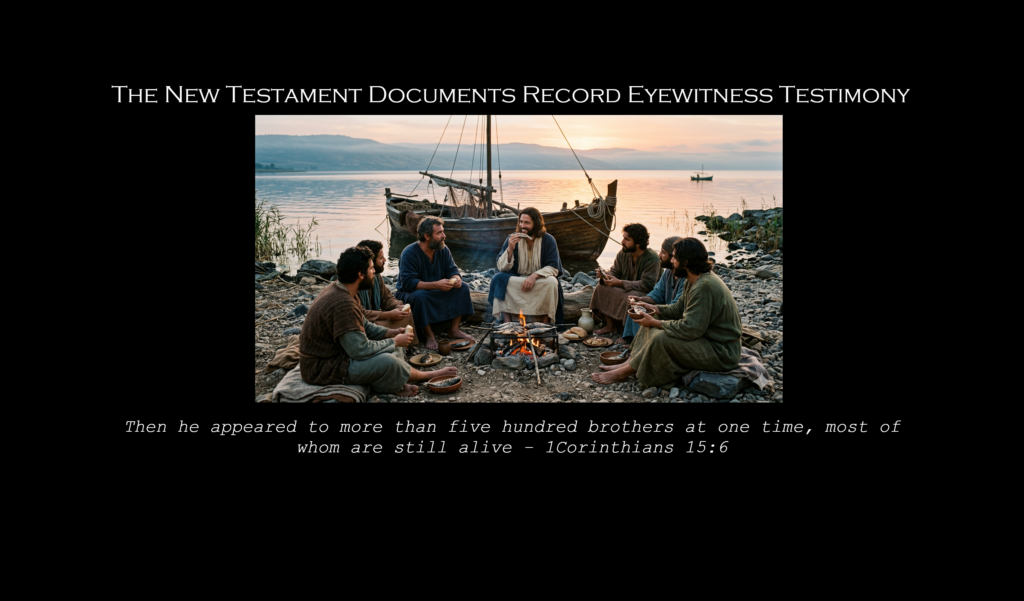
One of the central questions surrounding the New Testament is this:
Are the Gospels legends that developed over time, or are they rooted in eyewitness testimony?
This is not merely a theological issue. It is a historical one. Ancient documents can be evaluated by examining when they were written, how they were sourced, and whether they reflect the characteristics of firsthand reporting.
When the New Testament is examined using these criteria, a strong case emerges that its accounts are grounded in eyewitness experience.
Written Within the Lifetime of Witnesses
The Gospels are widely dated to the first century, within decades of the events they describe. That places their composition within the lifetime of people who had seen and heard Jesus.
This matters for a simple reason: eyewitnesses can correct false claims.
If the stories about Jesus had been fabricated or wildly distorted, contemporaries – both followers and opponents – would have had opportunity to challenge them. Instead, the message spread rapidly in the very region where the events allegedly occurred.
Legends typically require long periods to develop, especially in cultures with living witnesses. The timeline of the New Testament writings is too early to allow for the kind of mythmaking that takes generations to solidify.
Direct Claims of Eyewitness Sources
Some New Testament authors explicitly state their reliance on eyewitness testimony.
For example, the introduction to the Gospel of Luke explains that the author investigated events carefully and relied on those who were present from the beginning. This reads like the prologue of an ancient historian seeking to provide an orderly account based on direct sources.
In addition, several letters within the New Testament emphasize that the writers personally saw, heard, and interacted with Jesus. They frame their message not as philosophical speculation, but as testimony.
The early Christian proclamation was rooted in the claim: “We saw this happen.”
Inclusion of Embarrassing and Difficult Details
Eyewitness accounts often include unflattering information.
The Gospels portray the disciples as confused, fearful, and at times faithless.
Key leaders misunderstand Jesus. Peter denies Him publicly. Women – whose testimony was undervalued in that culture – are presented as the first witnesses to the resurrection.
If the goal were to invent a persuasive legend, these details would likely have been softened or omitted. Instead, they are preserved.
This pattern aligns with authentic memory rather than polished myth.
Specific Names and Concrete Details
The Gospels frequently mention specific individuals, locations, and cultural practices. These details suggest that the authors were either eyewitnesses themselves or closely connected to those who were.
In ancient storytelling, invented legends tend to remain vague. Eyewitness-based accounts, by contrast, often contain concrete markers that invite verification.
The inclusion of named individuals may indicate that these people were known within early Christian communities – living sources who could confirm or deny the reports.
The Cost of the Testimony
Many early Christian leaders faced persecution for proclaiming what they claimed to have witnessed. While people may die for beliefs they think are true, it is far less plausible that they would willingly suffer for something they knew to be fabricated.
The early Christian movement was built upon public claims about historical events – especially the resurrection of Jesus. Those claims were not presented as symbolic myths but as occurrences in space and time.
If the central figures were knowingly spreading falsehoods, their willingness to endure hardship and even death becomes difficult to explain.
Oral Culture and Reliable Transmission
First-century Jewish culture placed high value on memorization and faithful transmission of teaching. Rabbis and their disciples were trained to preserve and repeat instruction accurately.
Before being written down, the teachings of Jesus circulated in structured oral form within communities committed to preserving them. This was not a loose “telephone game,” but a culture accustomed to careful memorization and repetition.
When eventually recorded in written form, these traditions had already been preserved within living memory.
A Reasonable Conclusion
No historical investigation can recreate the past with absolute certainty. But history works by assessing probabilities.
When we consider:
- The early dating of the documents
- The explicit appeal to eyewitness sources
- The presence of specific and verifiable details
- The inclusion of difficult or embarrassing material
- The willingness of witnesses to suffer for their claims
The simplest explanation is that the New Testament writings are rooted in firsthand testimony.
Why This Matters
If the Gospels are based on eyewitness accounts, then they are not distant legends shaped by centuries of embellishment. They are windows into real events experienced by real people.
That does not automatically resolve every theological question. But it does mean the accounts deserve to be taken seriously as historical testimony.
The heart of Christianity rests on events that were claimed to have happened in history. If those claims come from those who saw them, then the conversation shifts.
It becomes less about myth – and more about what we will do with the testimony.